Showing posts with label senegal. Show all posts

Saturday, October 12, 2013

Mangroves bring wildlife back to Senegal coast

Crabs scuttle among mangrove roots in a dense riverbank forest in southern Senegal, where a major reforestation project is reviving wildlife and boosting the west African country's lukewarm economy.

"Everything you see here has been replanted. Before 2006, there wasn't a single tree," said Senegalese environmental activist and government minister Haidar El Ali in Tobor, a village near Ziguinchor, the main city of the Casamance region.

He gestured toward mangroves tied to stilts bordering the Casamance river, planted by his Oceanium environmental organisation to boost an area that experts said was severely depleted by deforestation, drought and increased salt levels in the water.


Read more..

Senegal's Youssou N'Dour returns to stage after leaving office | The New Age Online

Renowned Senegal singer Youssou N'Dour is set to return to the stage for a comeback, his entourage said on Friday, a month after a government reshuffle saw the icon lose his ministerial post.

The award-winning musician, known for his eclectic style, will perform a concert in Paris on October 12 which will be his "great return to the stage, the comeback of Youssou N'Dour the singer", said his spokesman Charles Faye.

N'Dour had been the country's tourism minister since April 2012 until he was unexpectedly left out of the cabinet assembled by new Prime Minister Aminata Toure in early September.

The hugely popular entertainer was instead appointed as an advisor to the president with the rank of minister, although his duties have yet to be specified.

In an interview with television station Africa24 last month, N'Dour said he now had more time to concentrate on his music -- a mix of traditional drumming with African-rooted Cuban sounds, American soul and rock.

The the rest of the story....

How salt miners save Senegal's Pink Lake

How salt miners save Senegal's Pink Lake

www.bbc.co.uk
Senegal's Lake Retba or Pink Lake is a famous tourist attraction where around 3,000 miners extract salt from its water and export it all over the region, reports BBC Africa's Laeila Adjovi.

Wednesday, January 2, 2013

Learning to Swim is the Answer to Africa's 'Hidden Catastrophe


2012-07-11-IMG5099XL.jpg
By--Jane Labous


Do you remember school swimming lessons? I'd be willing to bet that you share some kind of memory of that familiar routine - swimming bags and verruca socks; the elastic flick of swimming hats; the chlorine echo of the swimming teachers and the rush for the crisps machine afterwards? As a child I took these lessons for granted, just as I've always taken for granted the fact that I can swim. The singular freedom of pumping out 50 lengths of crawl is part of my valued leisure time; those childhood lessons instilled a lifelong love of the water.
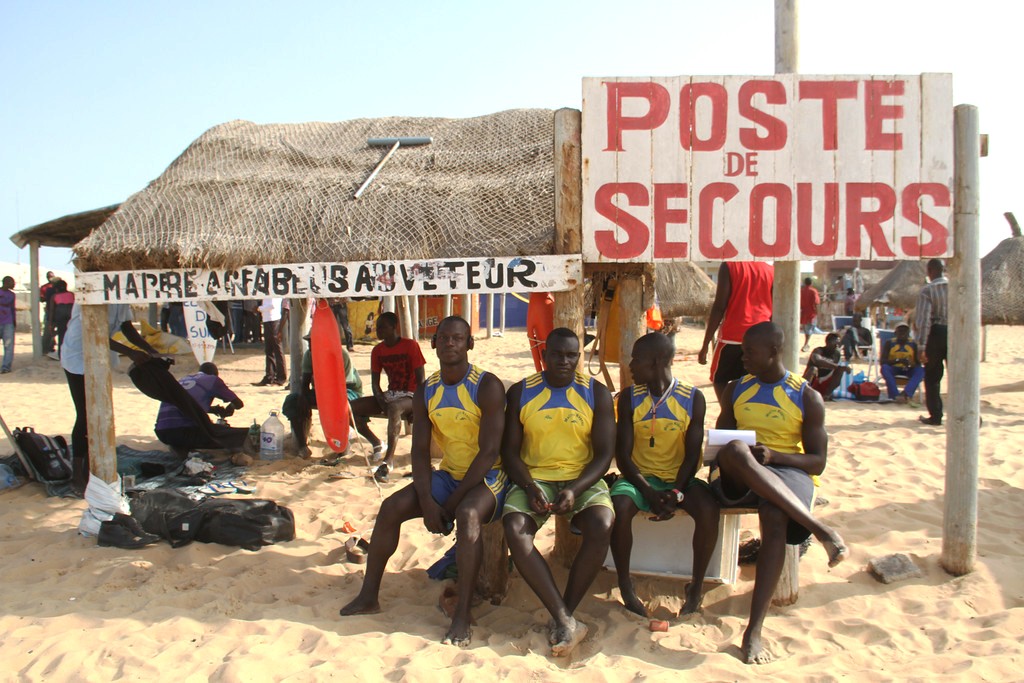
But in the developing world, swimming lessons aren't free or widely available or part of a standard childhood routine. Here in Dakar, Senegal, West Africa, a capital city surrounded on three sides by the sea, the majority of children grow up without learning to swim. There are few municipal pools, and who can afford £70 a month on private swimming lessons? With the exception of the coastalLebou fishing tribe, kids lack the skills to negotiate the often treacherous beaches, smacked by heavy Atlantic waves and pulled and pushed by violent currents. It's the same all the way down the coast, from Monrovia to Abidjan.
Yet nowadays, as village populations migrate en masse to these cities, and increased weekend leisure time means most children and teens flaunt parental warnings to stay away and head to the beach, knowing how to swim is becoming all too important. As many now die from drowning in the developing world as from malaria. But despite the scale of the problem, it's barely talked about - a hidden catastrophe.
At Yoff BCAO beach, one of Dakar's wildest and most dangerous, it's Sunday and there are about 2000 people, many of them unaccompanied children and teenagers. They form a seething, laughing, splashing shoreline mass; they're all having fun, but it's noticeable that none of them venture out of their depth. Small boys fill up water bottles as floats, a dangerous practice that means they risk being carried out to sea. None of them have armbands or proper floats. I speak to the urchins playing on the shore and they all say they cannot swim. Unanimously, they grin and tell me they'd love to learn.
My involvement with Yoff beach goes back to October 2011, when I met a group of Dakarois who operate a rudimentary lifeguarding service here. Led by Moustapha Diene, 52, a former fishermen, and Idrissa NDiaye, 33, a professional fireman and freediver, both from the Lebou tribe, they began saving lives voluntarily because they couldn't bear to stand back as so many children drowned. Despite a tangible decrease in the number of drownings on this stretch of the beach since they began surveying it, the government is reluctant to give them further funds and equipment. They get by with a few adapted fishing floats, a tank of oxygen, an old windsurfing board - and superlative swimming skills. It occurred to me that they could do with talking to our British lifesaving experts, the RNLI.
After months of hard work and not a little drama (our race through the hot streets of Dakar, looking for the right visa form, Moustapha sporting a kingly silver robe, is particularly memorable), Idrissa and Moustapha are now enrolled on the Royal National Lifeboat Association's (RNLI) brand new Development Programme. The programme will bring two lifeguards from nine developing countries (Senegal, Cameroon, Kenya, Uganda, Tanzania, Mauritius, Bangladesh, India and the Philippines) to a summer lifeguarding camp at the RNLI headquarters in Poole this August, for two weeks' intensive leadership training. During the winter, the RNLI lifeguards will return to Senegal (and the other countries) to help Idrissa and Moustapha improve their service and carry on training future lifeguards.
Drowning is preventable. The RNLI has years of experience in saving lives at sea, on inland
waterways and in floods. The programme is designed to share that expertise to reduce drownings worldwide, providing others with the knowledge, equipment and skills to save more lives and bringing to Africa the kind of superior lifeguarding services that we so take for granted on the beaches of the South West every year. Dakar's maitres naguers sauveteurs are really good, but with further training by the RNLI they'll have the base knowledge to improve and expand their service.
It's a significant start - but there's more to be done. In the long term, Idrissa, Moustapha and I would like to link up with NGOs like the one I work for - child rights organisation Plan International - and introduce free swimming lessons for children in Dakar and eventually, the rest of Africa. We'd also like to help the RNLI link up to further lifeguarding services in Africa.
Swimming is rightly considered, here in the UK and most other developed countries, to be a fundamental life skill. Teach a child to swim and he or she will always swim. Teach a child to swim in Africa and he or she also has more chance of surviving in rough seas; more chance of surviving a flood; more chance of surviving that tricky river crossing on the way to school. If a child is taught swimming survival and safe rescue skills, he or she will use them to protect their peers. Grown-up, they will pass those skills on to their own children. I would argue that teaching a child to swim in a city such as Dakar is as important as vaccinating them against major diseases.
Idrissa brings the point home as he describes, visibly upset, an accident that happened this week in Malika, on the outskirts of the city.

Lake Retba In Senegal's Pink Lake


A boat floats on what looks like a huge strawberry milk-lake.
The wooden vessels were photographed from the air bobbing on Lake Retba, in Senegal.
From above the mass of water - which spans one square mile - looks staggeringly similar to a giant milkshake.
lake retba
Giant milkshake: High levels of salt cause the water to change colour
And just like the Dead Sea swimmers are even able to FLOAT on the water with ease.
The bizarre colour is caused by high levels of salt - with some areas containing up to 40% of the condiment.
Michael Danson, an expert in extremophile bacteria from Bath University, said: "The strawberry colour is produced by salt-loving organism Dunaliella salina.
lake retba
Pink on white: The dramatic change in colour as the water meets the shore
"They produce a red pigment that absorbs and uses the energy of sunlight to create more energy, turning the water pink.
"Lakes like Retba and the Dead Sea, which have high salt concentrations, were once thought to be incompatible with life - hence the names. But they are very much alive."
Salt collectors can often be seen scouring the expanse to remove the valuable mineral - but first have to coat their skin with sheer butter.
This helps protect their skin from exposure to the intense salt levels in the three metre deep lake.
lake retba
Villagers process and sell the mineral
Salt crystals cling to the bodies of miners who work the lake everyday to extract its contents.
And towering piles of collected salt litter the shoreline.
Villagers then process it before selling and using the valuable mineral.

Tuesday, January 1, 2013

Senegal Expat Community Resources

Are you thinking about, or just found out you are moving to Senegal? Do you needing information about living in Senegal? Don't panic....online are several expat community websites and blogs.


InterNations


Senegal: Grandmothers Taking the Lead Against Female Genital Mutilation

Bamako — In the southern Senegal village of Kael Bessel, female genital mutilation is no longer a taboo subject. Sexagenarian Fatoumata Sabaly speaks freely about female circumcision and girls' rights with her friends.

"We've found it necessary to abandon cutting - abandoning the practice has advantages for women," she told IPS. "Female circumcision has consequences such as haemorrhaging and it can even lead to death."

In Senegal, like other West African countries, grandmothers like Sabaly are generally the ones who decide girls should be circumcised. A 2008 survey in Vélingara, also in the south of Senegal, found nearly 60 percent of older women supported female genital mutilation. But a 2011 survey carried out by the Grandmother Project found fully 93 percent of the same group are now against FGM.

The Grandmother Project, an international non-governmental organisation which promotes community dialogue about cultural issues, has helped organise regular meetings in thirty-odd villages around Vélingara, to enable people to discuss questions relating to local traditions and values, particularly "koyan" - the rite of passage associated with FGM.

Religious leaders, traditional chiefs, local officials, youth and elders all take part. The public debates allow people to talk openly about the pros and cons of their cultural practices.

Delta Airlines Flights to Senegal


NEW YORK TO DAKAR FLIGHTS, STATS AND AIRPLANES

Route information for flights from John F. Kennedy Intl. to Leopold Sedar Senghor Intl..
Distance:
3,802.73 miles

Airline carriers and aircraft used on flights from JFK to DKR

Tuesday, December 4, 2012

First Lady Marieme Faye Sall


First Lady Marieme Faye Sall

\First LadyMariemeFaye Sall

Joyce Banda of Malawi, the newest President of an African country–and only the second sitting African president who is a woman–is getting all the love for her achievements.* (So what if her ascendency came about due to the death of an aging president and his politically weak, colluding brother?). There is also much chatter on the internet about Malawi’s new First Gentleman, retired Chief Justice Richard Banda (with whom Madame Banda has two children). However, the Senegalese might suggest that their country’s new first lady, Marieme Faye Sall, represents a “bigger” deal in how her move to the presidential palace breaks with Senegal’s political history after independence.

Madame Sall’s husband, Macky Sall, has just been elected as President of Senegal. Her significance lies in the fact that she is the first woman of Senegalese birth and ancestry to become First Lady of Senegal. (Previous First Ladies have either been French or in the case of Madame Diouf of Lebanese descent.) This has made her a sensation, especially amongst Senegalese women; this is the first time they are seeing someone they recognize as one of their own in the presidential palace. Some more poetic accolades for her—within Senegal—have included “daughter of the land,” “a committed housewife,” “real Senegalese lady,” and “future burner of thiouraye (a secret mixture of oils, perfumes, seeds and fragrant wood used as a body [perfume], with an exotic, sweet, spicy, herbal aroma) and harbinger of Africa-ness to the state residence.” Top that if you can, Madame Banda.

Read the rest of the Story....


CNN INTERVIEW


Sunday, December 2, 2012

Omar Pene - Senegal Blues


Omar Pene - Senegal Blues

Omar Pene (born 1956 in Dakar) is the emblematic lead singer of the Super Diamono.

He was born in the working-class neighborhood of Derkle, in 1956. In the mid 1970s (1975–1976), he joined the Super Diamono, one of the longest running Senegalese popular bands- just as the Orchestra Baobab and the Super Etoile of Dakar. Recruited by Bailo Diagne, the first bass-player and a founding member of the group, Pene stood out as the most natural fixture in the band.

Along with his band members Bassirou Diagne, Bob Sene, Aziz Seck, Lapa Diagne, Adama Faye, Abdou Mbacke and shortly after, Ismael Lo - already known as 'l’homme orchestre' (one man band) due to his solo performances - they helped shape Senegalese contemporary music.During the 1980s, in Dakar, there were two dominant types of melomanes, the ones bitten by the frenetic and highly syncopative Mbalax of the Super Etoile, who frequented Djender and later on Thiossane night club, and those who religiously consumed the progressive bluesy-funky- soulful brand of local fusion of Super Diamono- who filled the Balafon Club located in the other side of town, near the Port Autonome de Dakar. Although Omar Pene and Youssou Ndour, always maintained an healthy and lively artistic competition, their supporters pledged a loyalty only seen among opposing football fans (soccer). In many ways, both used the Mbalax, which is almost unavoidable, once the Sabar is involved, but they did it differently.

Over the years many of the group’s original members went on to other things, Omar Pene stayed; and to this day- even as he is now enjoying his solo journey he uses the Super Diamono, and what ever that is left of it, as a backup band. Omar Pene established himself as a “conscious singer,” instead of indulging in praise songs- as many of his contemporaries did in honor of the riches and famous, he maintained a repertoire of socially engaged and sensitive songs. To this date, he has released dozens of hits in more than thirty albums and cassettes.

Omar Pene Fan Site


Stone Circles of Senegambia

Stone Circles of Senegambia

UNESCO World Heritage Site

The site consists of four large groups of stone circles that represent an extraordinary concentration of over 1,000 monuments in a band 100 km wide along some 350 km of the River Gambia. The four groups, Sine Ngayène, Wanar, Wassu and Kerbatch, cover 93 stone circles and numerous tumuli, burial mounds, some of which have been excavated to reveal material that suggest dates between 3rd century BC and 16th century AD. Together the stone circles of laterite pillars and their associated burial mounds present a vast sacred landscape created over more than 1,500 years. It reflects a prosperous, highly organized and lasting society.

The inscribed site corresponds to four large groups of megalithic circles located in the extreme western part of West Africa, between the River Gambia and the River Senegal. These sites, Wassu, and Kerbatch in Gambia, and Wanar and Sine Ngayene in Senegal, represent an extraordinary concentration of more than 1,000 stone circles and related tumuli spread over a territory of 100 km wide and 350 km in length, along the River Gambia. Together, the four groups comprise 93 circles and associated sites, some of which have been excavated, some of which have revealed archaeological material and human burials, from pottery to iron instruments and ornamentation dating between the 1 st and 2nd millennia to our era. These four megalithic sites are the most dense concentration in the zone and have Outstanding Universal Value, representing a traditional monumental megalithic construction spread out over a vast area, with more than 1,000 stone circles scattered along one of the major rivers of Africa.
The Sine Ngayene complex (Senegal) is the largest site in the area. It consists of 52 circles of standing stones, including one double circle. In all, there are 1102 carved stones on the site. Around 1km to the east, (outside the inscribed property) is the quarry from which the monoliths were extracted and where the sources of around 150 stones can be traced. The site was excavated around 1970, and more recently by Bocoum and Holl. The work established that the single burials appeared to precede in time the multiple burials associated with the stone circles. The Wanar complex (Senegal) consists of 21 circles including one double circle. The site contains 9 ‘lyre’ stones or bifed stones, sometimes with a cross piece strung between the two halves. The Wassu complex (Guinea) consists of 11 circles and their associated frontal stones. This site has the highest stones of the area. The most recent excavations conducted on these megalithic circles date to the Anglo-Gambian campaign led by Evans and Ozanne in 1964 and 1965. The finds of burials enabled the dating of the monuments between 927 and 1305 AD. The Kerbatch complex consists of 9 circles, including a double circle. The site possesses a ‘bifid’ stone, the only known one in the area.
The stones forming the circles were extracted from nearby laterite quarries using iron tools and skilfully shaped into almost identical pillars, either cylindrical or polygonal, on average around 2 m in height and weighing up to 7 tons. Each circle contains between eight to fourteen standing stones having a diameter of four to six metres. The four megalithic sites inscribed bear witness to a prosperous and highly organized society with traditions of stone circle constructions, associated with burials, and persisting in certain areas over more than a millennium.


Saturday, September 29, 2012

Delta to launch first direct flights between US and Angola

LUANDA — US carrier Delta Air Lines announced Wednesday it will launch the first direct commercial flights between the United States and Angola in January, as it moved to expand it presence on the continent.

Delta, which has manoeuvred since 2008 to be the first to launch direct flights between the two countries, said it saw strong market potential in Angola where thousands of Americans work in the oil and humanitarian sectors.

"Delta is committed to expanding our presence into fast-growing African markets to better serve our global business travelers," senior vice president Perry Cantarutti said in a statement.

"This new service between Atlanta and Luanda will shave hours off of business travellers? itineraries between the US and Angola thanks to more direct routings," he said.

Flights will operate three times a week between Atlanta and Luanda via Dakar, and will be available from October 2.

Read more....

Sunday, May 6, 2012

Senegal's Fashion Victims

Skin Bleach???

To see the effects of racism based on skin color most clearly, one should go to the developing world. In richer countries people are increasingly comfortable, and successful, regardless of their natural skin color, but in many African countries like Senegal, trying to change one's skin color is still seen as a way to get ahead.
"Some Senegalese women," Emilie, a student at Dakar University, told ABC News, "are trying to look like the white girls they see on television."


From ads on highway billboards, to little stands in marketplaces, skin bleaching products are 
almost everywhere.

They sell well, despite what public health officials say are grave risks of using them, including cancer.


Sami Sosa

The cheapest creams cost around $5 per tube, a small fortune in Senegal, and they are also among the most dangerous.

At a market in Dakar, a young hairdresser who was unwilling to reveal her name told ABC News she had used the creams. "It's more beautiful to have lighter skin. A bit lighter, it's a bit better," she said.


Read the rest of the story by ABC News BEN BARNIER    

Senegal revokes licences of foreign fishing trawlers


Senegal Fishing
Government demands that 29 ships offload their catches before leaving the west African country's territorial waters.

The new government of Senegal has cancelled the licences of 29 foreign fishing trawlers, demanding that they offload their catches in the capital Dakar before leaving the west African country's territorial waters.

The dramatic move on Tuesday by fisheries minister Pape Diouf follows growing resentment at overfishing and alleged corruption of the previous government's licencing system. It is expected to defuse threats by Senegal's 52,000 small-scale inshore fishermen to take direct action against the owners of foreign trawlers.

In 2006, Senegal cancelled its licencing agreements with the heavily subsidised EU fleet in an attempt to protect its industry from foreign vessels. But dozens of giant 10,000-tonne factory ships registered in Russia, Lithuania, Morocco, Ukraine, Mauritius, Saint Vincent and the Grenadines, China, Belize and elsewhere were able to acquire new licences. Using satellite technology and often working together, they have been able to take hundreds of tonnes of fish a day.

Read the rest of the story by  John Vidal.....

Senegal revokes licences of foreign fishing trawlers....

Sunday, April 8, 2012

Saloum Delta Islands - Senegal


Saloum Delta Islands
The River Saloum Delta, four hour ride from Dakar, consists of an archipelago of small islands which are home of ecotourism practice. It is in this region that the Saloum Delta National Park is located. It is a river delta formed by the confluence of two rivers : the Sine and the Saloum.Because it flows so slowly, this delta allows saltwater to travel deep inland.
Kaolack : The region's capital Kaolack is resolutely modern and bustles with activity: crossroads, commercial port, holy city for the Tidjane brotherhood and capital of groundnut and salt-marshes. The city also home to one of the largest markets in the country with a neo-Moorish style whose architecture . Not far from there, you will be able to discover a number of megalithic sites similar to "Breton standing stones".

Fishermen villages : Fishermen villages along the coastline and those set up along the meanders of the Sine and Saloum Rivers are great authentic sites; visiting these villages represents a unique occasion to understand the daily lives of the inhabitants of this region.

Foundiougne : Located on the left bank of the 


Saloum Delta Islands
Saloum and accessible by ferry, this peaceful village has kept its charm of yesteryear with its old buildings and its streets lined with mango trees.

Missirah : Built against the forest, this village is organised around a port and its dugout workshop. A small local specificity: fishermen sell their fish by suspending them from the handlebars of their bicycle.

Toubakouta : Known not only for its Senegalese wrestling competitions but also for the talent of its artisans and notably its sculptors, the village is also a crossroads for two ethnic groups: the fishermen Serer and the farmers Mandinka.

Dionevar Island : This is an island not to be missed! Mainly populated with Nominka, excellent fishermen from the Serer group, you will be enchanted by the charm of its architecture, its richly-coloured houses decorated with shells as well as a luscious environment where groundnut and rice cultivations are planted alongside coconut and lemon trees. Gourmets will succumb to the specialty of grilled molluscs served with rice.

The Saloum Delta National Park is a wonderful natural environment and a unique attraction for those who want to know the real Senegal and appreciate its beauty. It is a true natural paradise where live birds (pelicans, herons, marabous and hundreds of other species), fish, crustacean, dolphins, hyenas, jackals. The wealth of water makes it a very sought after area for fishing enthusiasts but also it allows people to live on fishing.
  

Saloum Delta Islands

The richness of the Saloum Delta National Park is, definitely, the variety of itsecosystems. Composed of three main island groups (Fathala, Gandoune and Betenty): the three major island groups include a myriad of small islands.

This humid region of Senegal has been listed in Ramsar in 1984. The Ramsar Treaty is an agreement signed by 150 countries to protect the wetlands on the planet. The mangrove islands serve as refuges for rare and endangered. Reptiles are numerous. Crocodiles, snakes, lizards, chameleons and turtles each evolve in their environment and provide even more amphibian fauna of the park. The fishes in the delta are breeding exceptional count 114 species. Over 40 species of fish of the Senegal coast come to feed in the delta and 44 species breed there.

Nearly 200 000 people live in the park or in its immediate neighbours and live on fishing and on the park tourism (ecotourism, hunting or sport fishing).The main economic activity is fishing. Transportation is difficult because of the many islands.A secondary economy is the construction of fishing boats.The salinity of the water is increasing due to mismanagement of the rivers upstream. Mangroves are disappearing, and freshwater fish are disappearing with them. 

Saloum Delta Islands


The Sine-Saloum Delta is further characterized by the presence of notable species such as manatees, river dolphins, and the highly endangered red colobus monkey to the extreme of its range. As for flora, with 188 plant species, it is mainly composed of a variation of  mangrove plants.
Visit page for  Senegal Destinations.
 

Thursday, March 22, 2012

Seven things to do in Casamance - Senegal

Top "7" Seven Things to do in Casamance
(In no particular order)

Things to do in Casamance
 Djibelor
There is a protected forest at Djibelor. Great place to
spot fantastic,butterflies and birds. Also you will find  a farm that is open to visitors with some wildlife exhibit. Great diversity of tree and wildlife with 30 acres of different species..tropical fruit(Pineapple,aloe vera ,etc. ). Like croc's go to the back of the farm to find a crocodile farm,where you can get close to Nile crocs in all ages and sizes.

Carabane Island
Things to do in Casamance

Also known as Karabane, is an island and a village located in the extreme south-west of Senegal, in the mouth of the Casamance River. Although most of Carabane is covered in .mangroves, its coconut trees and sandy beaches attract tourists.Carabane may also be accessed by a two or three hour boat trip from Ziguinchor. While Basse Casamance National Park and Kalissaye Avifaunal Reserve have not been open for years due to the Casamance Conflict, Carabane has been found to be very good place for bird watching.

Carabane has many historic sites, such as the Catholic mission house built in 1880 which has since been turned into a hotel, a Brittany-style church building which is no longer in use, and a former slave-trade building. There is also a French cemetery where a Troupes de marine-Captain with the name Aristide Protet was shot with a poisoned arrow and buried standing up in front of the sea, according to his last wishes


Kafountine - Kailo Island

Things to do Dakar
 Is Senegals the largest fishing village. in the Casamance region of Senegal.The drive from Ziguinchor to Kafountine takes about 2 hours. Add to this the re-occurring stops for the military, toll road keepers and animals, and the drive can stretch out to 3 hours. Board a boat to Kailo Island. This Island is occupied by animists.


Animism is based on the belief that natural objects and idols or fetishes have magical power.


Thing to do in Casamance


Cap Skirring
Oh.. its wonderful sandy beaches.(they say the finest beaches in Senegal ) also spelled Cap Skiring. A town on the Atlantic Ocean coast of the Basse Casamance (Ziguinchor) region of Senegal. It is a popular seaside resort with Europeans. It has everything you need for a perfect  seaside holiday, From its golden sandy beaches lined with coconut palms to it warm waters and vast areas where you can find peace and quiet. This former sleepy fishing visit is a must stop for Casamance.
 

Edioungou


Things to do in Casamance
Edioungou Village located about 40 km from Ziguinchor. a small isolated village in the middle of the mangrove. The only access road is the river.

Edioungou is famous for its pottery. You can watch a demonstration by local women creating pottery. The work is distinctive because they add a mixture of soil and crushed shells to the clay before firing. Afterward you must purchase a pot as souvenir of you lovey day in Endioungou.

Ziguinchor
Things to do in Casamance


The standard day trip from Ziguinchor includes a pirogue trip. This is by far the best way to visit a lot of the Islands on the Casamance River (sometimes the only way). Ports of call are..... Affiniam and Djilapao on the northern side of the Casamance River and a trip to Île des Oiseaux. in Djilapao, you can see some beautiful cases à étages (traditional two-storey mud houses). The Island of Oiseaux is great for bird lovers; with very little effort you can see pelicans, flamingos, kingfishers, storks and sunbirds as well as many more species.

Oussouye
Things to do in Casamance

  Halfway between Zinguinchor and Cap Skiring. Known for its bicycle tourism....Contact Benjamin of Casamance VTT. They rent bikes for full or half day tours of the area.

The trails are rolling, sometimes broad and passable, mostly narrow paths and secrets used by people to go in the woods, the fields or go from village to village.


Visit our page for ..Things To Do In Senegal

Sunday, February 26, 2012

Presidental Elections


DAKAR, Senegal — Voters booed Senegal’s president as he went to cast his ballot in elections Sunday, the latest sign of how his decision to seek a third term in office has caused his popularity to plummet and divided a country long considered a model of tolerance.

The unrest has threatened the reputation of this normally unflappable republic on Africa’s western coast, which has been held up as one of the continent’s most mature democracies. Read the Rest of the Story

Thursday, January 26, 2012

Africa Unchained: Dyana Gaye | Filmmaker

Dyana Gaye  
Africa Unchained: Dyana Gaye | Filmmaker: In Shadow and Act : French/Senegalese director Dyana Gaye , whose short film, the vibrant, unorthodox musical Saint Louis Blues , was o...  Read the Rest of the story


Visit our page for other Senegalese filmmakers and Artist.

Monday, January 23, 2012

Akon - Senegal International Rap Star


Aliaune Damala Badara Thiam, better known as simply Akon ( /ˈeɪkɒn/; born April 16, 1973), is a Senegalese American R&B recording artist and songwriter.
Akon
 Akon rose to prominence in 2004 following the release of "Locked Up", the first single from his debut album Trouble. His second album, Konvicted, earned him a Grammy Award nomination of the single "Smack That". He has since founded two record labels, Konvict Muzik and Kon Live Distribution.

Akon often sings hooks for other artists and is currently credited with over 300 guest appearances and 45 Billboard Hot 100 songs. Akon has worked with numerous performers such as Dr. Dre, Michael Jackson, R. Kelly, Bone Thugs-N-Harmony, Quincy Jones, Eminem and Whitney Houston. He is the first solo artist to hold both the number one and two spots simultaneously on the Billboard Hot 100 charts twice.He has had six Grammy Awards nominations and has produced many hits for artists such as Lady Gaga, Colby O'Donis and Leona Lewis. Lady Gaga and T-Pain are two artists who were given their chance at fame by Akon.


Akon

Akon was born in St. Louis, Missouri, which his parents arranged so that he would have American citizenship, and not encounter future immigration problems. He is the son of Senegalese percussionist Mor Thiam, Akon was raised in a musical setting and taught to play several instruments including the djembe. At age 7, he moved with his family to Union City, New Jersey, splitting his time between the United States and Senegal until settling in Newark, New Jersey. 


Visits Wikipedia for more info on Akon the Senegal Rap Star.
Visit our Senegal Music page.

Thursday, January 12, 2012

Festival of Jazz - 20th Annual - St .Louis Senegal - May 2012


St. Louis Jazz Festival Senegal
Festival of Jazz  - 20th Annual  - St. Louis - Senegal May  24th - 28th,  2012
St. Louis Jazz Festival 2012 will be showcasing Jazz, blues, gospel and related music. More than an event, the Festival International de Jazz de Saint-Louis has become a must in the cultural and musical landscape of Senegal,a major African Festival, but which is always something unexpected!Past musicians who took part in the Saint Louis Jazz Festival include Herbie Hancock, Randy Weston, and Joe Zainul. The African Festival is also an excellent platform for new jazz groups to perform infront of an international audience. At least 30 new groups perform each year. Enjoy some of the world’s best jazz, exotic food, art and crafts, culture exhibits and also some African drum-beat dancing. 

St. Louis Jazz Festival Senegal
The proposed programming for the 20th Edition Saint Louis Jazz Festival will be electric, bringing together big names of jazz from all  generations.


Featured Artist 2012
  • Kate Winter Sextet
Will keep you updated on confirmed artist for event


Featured Artist in Past

  • Mike Del Ferro  
  • Malouma Duo 
  • Enjhambre Quartet
  • Chico Correa 
  • Sonja Kandels
  • Michaela Rabitsch
  • Kenny Barron Trio
  • Jean-Pierre Como 
  • Mina Agossi
  • St. Louis Jazz Festival Senegal
  • Ablaye Cissoko

Art Show
During this African Jazz festival of St. Louis, all the artistic expressions are invited.There will also be a Art show featuring artist for all over Senegal and the children of St. Louis.

Official Website: Festival of Jazz 2012