
Showing posts with label dakar. Show all posts

Wednesday, January 2, 2013

Learning to Swim is the Answer to Africa's 'Hidden Catastrophe


2012-07-11-IMG5099XL.jpg
By--Jane Labous


Do you remember school swimming lessons? I'd be willing to bet that you share some kind of memory of that familiar routine - swimming bags and verruca socks; the elastic flick of swimming hats; the chlorine echo of the swimming teachers and the rush for the crisps machine afterwards? As a child I took these lessons for granted, just as I've always taken for granted the fact that I can swim. The singular freedom of pumping out 50 lengths of crawl is part of my valued leisure time; those childhood lessons instilled a lifelong love of the water.
But in the developing world, swimming lessons aren't free or widely available or part of a standard childhood routine. Here in Dakar, Senegal, West Africa, a capital city surrounded on three sides by the sea, the majority of children grow up without learning to swim. There are few municipal pools, and who can afford £70 a month on private swimming lessons? With the exception of the coastalLebou fishing tribe, kids lack the skills to negotiate the often treacherous beaches, smacked by heavy Atlantic waves and pulled and pushed by violent currents. It's the same all the way down the coast, from Monrovia to Abidjan.
Yet nowadays, as village populations migrate en masse to these cities, and increased weekend leisure time means most children and teens flaunt parental warnings to stay away and head to the beach, knowing how to swim is becoming all too important. As many now die from drowning in the developing world as from malaria. But despite the scale of the problem, it's barely talked about - a hidden catastrophe.
At Yoff BCAO beach, one of Dakar's wildest and most dangerous, it's Sunday and there are about 2000 people, many of them unaccompanied children and teenagers. They form a seething, laughing, splashing shoreline mass; they're all having fun, but it's noticeable that none of them venture out of their depth. Small boys fill up water bottles as floats, a dangerous practice that means they risk being carried out to sea. None of them have armbands or proper floats. I speak to the urchins playing on the shore and they all say they cannot swim. Unanimously, they grin and tell me they'd love to learn.
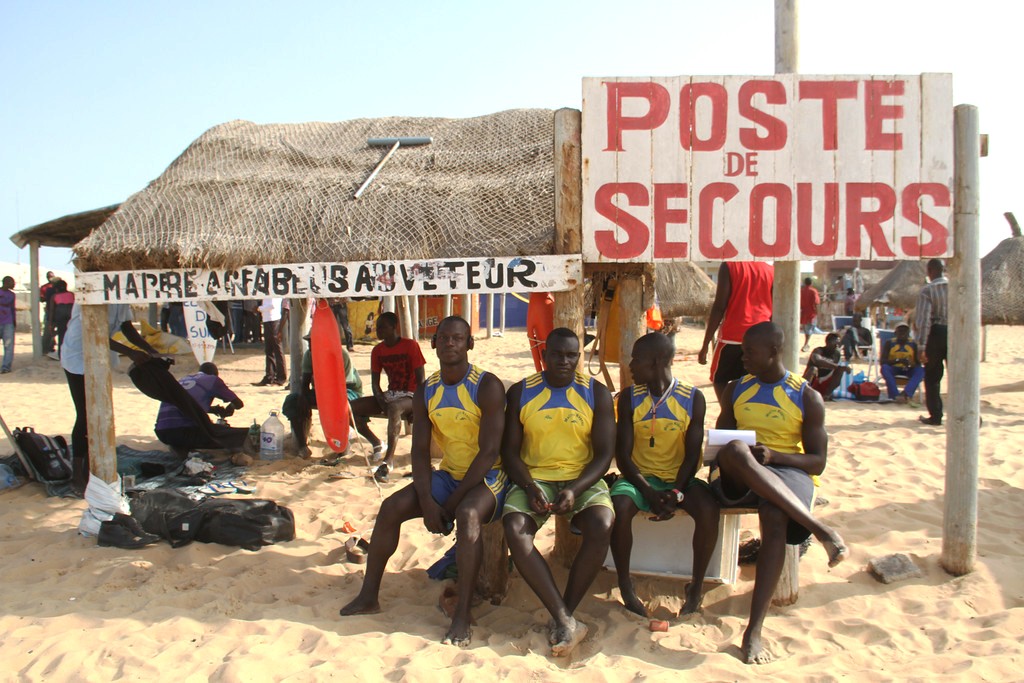
My involvement with Yoff beach goes back to October 2011, when I met a group of Dakarois who operate a rudimentary lifeguarding service here. Led by Moustapha Diene, 52, a former fishermen, and Idrissa NDiaye, 33, a professional fireman and freediver, both from the Lebou tribe, they began saving lives voluntarily because they couldn't bear to stand back as so many children drowned. Despite a tangible decrease in the number of drownings on this stretch of the beach since they began surveying it, the government is reluctant to give them further funds and equipment. They get by with a few adapted fishing floats, a tank of oxygen, an old windsurfing board - and superlative swimming skills. It occurred to me that they could do with talking to our British lifesaving experts, the RNLI.
After months of hard work and not a little drama (our race through the hot streets of Dakar, looking for the right visa form, Moustapha sporting a kingly silver robe, is particularly memorable), Idrissa and Moustapha are now enrolled on the Royal National Lifeboat Association's (RNLI) brand new Development Programme. The programme will bring two lifeguards from nine developing countries (Senegal, Cameroon, Kenya, Uganda, Tanzania, Mauritius, Bangladesh, India and the Philippines) to a summer lifeguarding camp at the RNLI headquarters in Poole this August, for two weeks' intensive leadership training. During the winter, the RNLI lifeguards will return to Senegal (and the other countries) to help Idrissa and Moustapha improve their service and carry on training future lifeguards.
Drowning is preventable. The RNLI has years of experience in saving lives at sea, on inland
waterways and in floods. The programme is designed to share that expertise to reduce drownings worldwide, providing others with the knowledge, equipment and skills to save more lives and bringing to Africa the kind of superior lifeguarding services that we so take for granted on the beaches of the South West every year. Dakar's maitres naguers sauveteurs are really good, but with further training by the RNLI they'll have the base knowledge to improve and expand their service.
It's a significant start - but there's more to be done. In the long term, Idrissa, Moustapha and I would like to link up with NGOs like the one I work for - child rights organisation Plan International - and introduce free swimming lessons for children in Dakar and eventually, the rest of Africa. We'd also like to help the RNLI link up to further lifeguarding services in Africa.
Swimming is rightly considered, here in the UK and most other developed countries, to be a fundamental life skill. Teach a child to swim and he or she will always swim. Teach a child to swim in Africa and he or she also has more chance of surviving in rough seas; more chance of surviving a flood; more chance of surviving that tricky river crossing on the way to school. If a child is taught swimming survival and safe rescue skills, he or she will use them to protect their peers. Grown-up, they will pass those skills on to their own children. I would argue that teaching a child to swim in a city such as Dakar is as important as vaccinating them against major diseases.
Idrissa brings the point home as he describes, visibly upset, an accident that happened this week in Malika, on the outskirts of the city.

Tuesday, January 1, 2013

Luggage shipping to Senegal

Luggage shipping to Senegal


The professional carrier will:
> manage the entire air or sea shipment of your belongings to Senegal;
> handle paperwork and customs clearance;
> pack or supply packaging;
> provide fully-comprehensive insurance. 

How to prepare your luggage shipping to Senegal

Choose the right container
You can use travel trunks, boxes, suitcases or travel bags. 
Choose the right formula
Before departure: the carrier can either collect your luggage at your address, or you can bring your luggage directly at the counter of the carrier.
Upon arrival in Senegal: the carrier can either deliver your luggage to your address, or you can pick up your luggage directly at the counter of the carrier.
Take the essentials
Select goods you want to bring with you to Senegal and goods you want to leave on the spot. Take advice: it might be more advantageous to rebuy goods in in Senegal instead of bringing them with you.
When will my luggage be delivered?
Delivery time depends on the destination country: allow up to 5 days by air freight and 6 weeks by sea freight.
Take out insurance
Zero risk does not exist. Loss and damage luggage insurance is highly recommended. 

Senegal Expat Community Resources

Are you thinking about, or just found out you are moving to Senegal? Do you needing information about living in Senegal? Don't panic....online are several expat community websites and blogs.


InterNations


Delta Airlines Flights to Senegal


NEW YORK TO DAKAR FLIGHTS, STATS AND AIRPLANES

Route information for flights from John F. Kennedy Intl. to Leopold Sedar Senghor Intl..
Distance:
3,802.73 miles

Airline carriers and aircraft used on flights from JFK to DKR

Sunday, May 6, 2012

Senegal revokes licences of foreign fishing trawlers


Senegal Fishing
Government demands that 29 ships offload their catches before leaving the west African country's territorial waters.

The new government of Senegal has cancelled the licences of 29 foreign fishing trawlers, demanding that they offload their catches in the capital Dakar before leaving the west African country's territorial waters.

The dramatic move on Tuesday by fisheries minister Pape Diouf follows growing resentment at overfishing and alleged corruption of the previous government's licencing system. It is expected to defuse threats by Senegal's 52,000 small-scale inshore fishermen to take direct action against the owners of foreign trawlers.

In 2006, Senegal cancelled its licencing agreements with the heavily subsidised EU fleet in an attempt to protect its industry from foreign vessels. But dozens of giant 10,000-tonne factory ships registered in Russia, Lithuania, Morocco, Ukraine, Mauritius, Saint Vincent and the Grenadines, China, Belize and elsewhere were able to acquire new licences. Using satellite technology and often working together, they have been able to take hundreds of tonnes of fish a day.

Read the rest of the story by  John Vidal.....

Senegal revokes licences of foreign fishing trawlers....

Tuesday, March 20, 2012

Is Senegal Safe for Tourist?

Sineta George - SenegalStyle
Security Concerns for West Africa in General & Senegal in Particular!

(Guest Blogger Sineta George owner of Senegal Style. Original post Thorn Tree Travel Forum)


 Hello again and Greetings from Senegal!

It's as safe now in Senegal (and Casamance) as it ever was as long as you stay away from obvious hot spots, political rallies and/or protests.

I originally did a post this summer on another online travel forum when there were protests about power shortages (which we don't have anymore) and now, here we go again.

We've got another travel advisory flagged for Senegal (because of the elections), in big red letters, a 'Travel Alert' - Safety Concerns and you have raised an important issue to many people that have never been to West Africa and therefore pay a lot of attention to these types of warnings. I wish to put this issue into perspective however.

Having said that, let me state for the record that I am an America woman, single parent of 3 young American adults that spent 12 years of their lives here in Senegal, with me. 2 are back in the US and I have one 18 yr old still in school, here in Dakar.

I moved here in 1999 BECAUSE it is such a peaceful and tranquil country.

Most people have never heard of Senegal because there's not been any wars, famine, epidemics (HIV/AIDS rate is less that 0.7%!), capital punishment, child pornography rings, slavery or anything else that would normally get a country in the news.

The Senegalese people are guilty only of exercising their civil rights - the freedom to protest against their government and every time they do, Senegal gets slapped with a travel advisory by western embassies, namely the US and Canada and then everyone else follows suit.

HOWEVER, and this is really the crux of the matter, in light of all the 'Occupy' wherever protests going on in the US and other places - why aren't there travel warnings to Washington, DC? New York? Greece? The Italian people are always having a protest about something and so is France but there isn't any (serious) travel warnings about those countries.

Did you ever wonder why?

To make another point, the 10 cities with the highest murder rates in America are (and I just googled it and you can do your own research, the results may change but the point is the same):

Jacksonville, FL
Miami, FL
Memphis, TN
Orlando, FL
Birmingham, AL
St Petersburg, FL
Tampa, FL
Dallas, TX
Los Angeles, CA
Atlanta, GA

As I said previously, I'm American and my home state is Florida. If you do a google search for a list of the top ten cities with the highest murder rates like I just did, you will find that Florida has 5 of the top ten per capital , (and to me, that's a 'security concern' ). Has anyone ever seen a 'Travel Advisory' to the state where Disneyland is located? (Number 4!) Atlanta, GA, Dallas, TX and Birmingham, AL are right next door and throw in Tennessee to the mix then it becomes 9 of the top 10 are in the south. That's sad.

If you look for the top ten LOWEST murder rates, Senegal comes in 2nd from the bottom. Iceland has the lowest murder rate, followed by a bunch of West African countries (6 all together out of 10) that ALWAYS get travel warnings issued against them!

This is where I got the info above from:
chacha.com/question/…comments

And again, using online states going from the bottom, being Iceland to #10, Oman:


Iceland
# SENEGAL
# BURKINO FASO
# CAMEROON
Finland
# GAMBIA
# MALI
Saudi Arabia
# MAURITANIA
Oman

Think about that. All these places (I put in caps for emphasis) are West African and have travel advisories against them. In some cases, yes a few people, adventure travelers in remote places and ngo people not following their security guidelines have died in some type of random violence in a year. Count them all up for 2011 and it's less than the body count over New Years in the US. Where I come from, a few people are murdered every weekend and random violence... let's not even go there! At least once a month someone goes 'postal' and shoots several people at once.

What's the difference but you're worried about safety over here?

Just because you have a visa to travel doesn't mean it's a safety shield from destiny or plain bad luck. Adventure travelers, people who meet a stranger, call him a friend and then go off in to remote locations with no plans, no local contacts, nothing, truly expect that nothing should happen to them BUT WHAT'S SURPRISING, is that nothing usually does.

Try doing this in your home country and see what happens to you. Africans are much more forgiving of western mentalities for 'thrill seeking' and adventure travel and put up with it every day.

This link:
mapsofworld.com/world-top-ten/countries-with…

Senegal is number 2 in the world with the fewest murders and Orlando (Disneyland) is the 3rd highest in America. Those crime rates are never reported on CNN or BBC or even Aljazeera are they?

What's wrong with this picture?

Don't change your travel plans folks, stay away from political rallies and exercise the same judgment here that you would if you were at home in a large city and you'll be fine.

The places we come from in the western modern world are way more violent than Senegal or any other '3rd world country' in West Africa will ever be!

Do your homework online and feel free to email me at SenegalStyle@gmail.com.

Doin' it SenegalStyle!
Sineta George - Google me; I'm legit!
Website:
http://senegalstyle.wordpress.com/http://senegalstyle.wordpress.com/

Monday, February 27, 2012

Senegal's Wade in tight race for third term

Senegal Elections 2012

Senegalese President Abdoulaye Wade was locked in a tight race with his main rival, Macky Sall, on Monday as unofficial vote tallies pointed to a possible run-off between the two for the leadership of one of West Africa's most stable countries.

Sunday's election followed weeks of violent street protests against the 85-year-old Wade's bid for a third term in office - despite a two-term limit - and international warnings that Senegal's reputation as a relatively peaceful democracy hangs in the balance. Read the rest of the Story....

Sunday, February 26, 2012

Presidental Elections


DAKAR, Senegal — Voters booed Senegal’s president as he went to cast his ballot in elections Sunday, the latest sign of how his decision to seek a third term in office has caused his popularity to plummet and divided a country long considered a model of tolerance.

The unrest has threatened the reputation of this normally unflappable republic on Africa’s western coast, which has been held up as one of the continent’s most mature democracies. Read the Rest of the Story

Friday, February 10, 2012

Senegal Grand National Theater

Senegal Grand National Theater
Senegal Blog
Senegal Grand Nation Theater

The 1800-seat Senegal National Grand Theater, is a  21 million Euro gift to the people of Senegal from China. It opened in April of 2011, replacing the current national theatre in Dakar, with a capacity of 1,100, that was built in 1965.

The Senegal National Grand Theater will mainly be used for singing and dancing performances, and can also work as cinema or conference hall as well. It will play an important role in satisfying the cultural needs of the Senegalese.

Built on an area of ​​about three acres, the Senegal National Grand Theater has a capacity of 1,800 seats and six floors.


Location: Carrefour Cyrnos x Boulevard de l'Arsenal

Please visit our page for Dakar Day Trips 
See the top  Seven things to do in  Dakar

Visit page for other Senegal Destinations
 
Senegal Blog

Saturday, January 7, 2012

Salon Michèle Ka - Hair Salon- Dakar Senegal

Michele Ka Salon Dakar Senegal

Salon Michèle Ka

Michele Ka, owner of a hair salon in Dakar, partners with,  Pascal 
Tribouillier , the Franco-Senegalese based in Paris and founder of the brand "Dayna."  The complete line of hair and scalp products  is inspired by the traditions of southern India.    The treatment starts with a relaxing scalp massage to remove tension and waste leaving joy.  The all natural products adapted to all different hair types.

According to Pascal  the beauty of the hair does is 

Michele Ka Salon Dakar Senegal

limited not just to beautiful hairstyles for women and men. It stems from a healthy scalp. Dayna is the all natural hair care line he uses which includes a wide range of products, from soap to shampoo through the cream, and oils.
Michele Ka Salon Dakar Senegal

The project, he said "is part of a fair trade and sustainable development, respectful of the environment and future generations. " He has teamed up with partners who are located in villages in southern India. According to him, "Dayna product compositions were inspired by the ancestral know-how, they are based solely on natural 
Michele Ka Dakar Senegal Salon

products. They are 100% natural products-No preservatives, anti-oxidants, synthetic perfumes or petrochemical derivatives.No testing is done on animals." 
Michèle Ka, in partnership with the brand "Dayna"  also showcases art at his funky-chic salon. Michele has a very diverse  customer base of African and other nationalities.

Contact Information


Michele Ka Salon Dakar Senegal Salon
Address
Tour de l'Œuf Point E
Hours
Monday to Saturday from 10h to 20h Sunday from 10h to 19h
Phone 33 824 7033
Website: Michele Ka 


Tuesday, January 3, 2012

Senegal Food

Senegal Food

Senegal Food and Dining

The cuisine of Senegal has been influenced by nations like France, Portugal, and those of North Africa, and also by many ethnic groups, the largest being the Wolof; 

Cuisine from all over the world can be found in Senegal, including Asian, Indian, Middle Eastern, and other international tastes. Fast food chains are rising in popularity due to convenience and their family oriented style.

Because Senegal borders the Atlantic Ocean, fish is an important staple. Chicken, lamb, pea, eggs, and beef are also used in Senegalese cooking, but not pork, due to the nation’s largely Muslim population. Peanuts, the primary crop, as well as couscous, white rice, sweet potatoes, lentils, black-eyed peas and various vegetables, are also found into many recipes. Meats and vegetables are typically stewed or marinated in herbs and spices, and then poured over rice or couscous or simply eaten with bread.


Drinks

Senegal Food

  • Toufam (a kind of yogurt thinned with sugared water).
  • Mint tea, the first cup drunk slightly bitter, the second with more sugar and the third very sweet.
  • Palm wine, which is drunk either fresh or fermented.
  • Home-roasted coffee with pimento.
  • Popular fresh juices are made from bissap, ginger, Buy (pronounced bouy) which is the fruit of the baobab tree and mango. 


National specialties
  • Thiéboudienne or Ceebu jën, flavorsome marinated fish cooked with tomato paste and a variety of vegetables, the national dish of Senegal.
  •  Yassa, chicken or fish simmered in onion with a garlic, mustard, and lemon sauce.
  •  Tiebou dienne (herb-stuffed fishcakes with rice).
  •   Maafe, seasoned fish, chicken, lamb, or beef cooked with vegetables in a peanut sauce.
  • Dem à la St Louis (stuffed mullet). 
  • Avocat au Crevettes (avocado stuffed with shrimp).
  • Bassi-salté, seasoned meat cooked with tomato paste and vegetables over a local couscous called "cere".
  • Sombi, sweet milk-rice soup.
  • Capitaine à la Saint-Louisienne, perch stuffed with spices.
  • Poisson à la braise, grilled fish flavored with lemon, garlic, and black pepper.
  • Dibi, simmered, grilled lamb.
  • Thiou, a bouillabaisse with vegetables.
  • Fondé, rolled millet-balls in sour cream.

 Desserts

  • Thiakry, a couscous pudding.
  • Cinq Centimes, the Five-Cent Cookie, a peanut cookie popular in marketplaces.
  • Banana Glace, a sophisticated banana dessert . Mamadou is the young owner of Les Cannibales Deux Restaurant in Dakar who went to Paris to learn French cooking techniques. The Banana Glace is his own creation and his most popular dessert. Click here for recipe


How a Dinner is Served out  in Senegal

When dining in one of the excellent Senegalese restaurants, you will select an appetizer from a list of twenty or twenty-five, all prepared with great care. The soups will be rich and full-bodied. There will be entrees in abundance; Yassa, Mate, and beautiful Couscous among them. Then a long list of fancy desserts, all served with great flair.

Or you might be served at one of the open-air restaurants where food is cooked on small tournieres, or broilers, which look like hibachis. They average about 15 inches in diameter and are sometimes round and sometimes square. The fourniere has a grate at the bottom and heat is regulated by adding or removing hot charcoal with tongs as required.

Senegal Market
Tipping: A service charge of 10 to 15% is included in all hotel and restaurant bills.

At Home 
Senegalese table manners can be somewhat formal. Wait to be shown to your seat. Seating is often a matter of hierarchy. A washing basin will be brought out before the meal is served for people to wash their hands. Woman and men may eat at separate tables in the same room or they may eat in separate rooms.  If the meal is served on the floor or a low table, sit cross-legged. Try not let your feet touch the food mat.  Do not begin eating until the eldest male does.  Food is often served from a communal bowl.  Eat from the section of the bowl in front of you. Never reach across the bowl to get something from the other side. Eat only with the right hand.Expect to be urged to take second helpings. Sample each dish.Leaving a little bit of food on your plate or your section of the communal bowl indicates that you have been looked after.
I
It is customary to give a small gift when invited to someone’s home for a meal.If invited to someone’s home, take a box of chocolates, French pastries or a nicely packaged fresh fruit.Gifts should be given with both hands. Never use the left hand.

Thursday, December 29, 2011

IFAN Museum of African Arts - Dakar Senegal


IFAN Museum of African Arts 

The Musée de l'Institut Fondamental d'Afrique Noire or IFAN Museum of African Arts in Dakar, Senegal is one of the oldest art museums in West Africa. It was promoted by Léopold Senghor, the country's first President.

 In December 2007, its official title was changed to The Théodore Monod African Art Museum ("Musée Théodore Monod d'Art africain"), after the French naturalist Théodore André Monod, former director of IFAN.[1] Previously its official name had been "Le Musée d'Art africain de l'Institut fondamental d'Afrique noire Cheikh Anta Diop IFAN/CAD".


IFAN Museum of African Arts 

The museum is part of the Institut Fondamental d'Afrique Noire (IFAN) institute, founded 1936 under the Popular Front government in France. When IFAN was transferred to Cheikh Anta Diop University in 1960, the building at Place Soweto near the National Assembly of Senegal was converted into a museum. 

It is today one of the most prestigious centers for the study of African culture and part of the Cheikh Anta Diop University. As the main cultural research center of the colonies of French West Africa, it contains important collections from across Francophone Africa.


The museum is one of the regular locations used in the Dakar Biennale exhibition, showing art by contemporary African and diaspora artists.


Contact information:
Place Soweto, Plateau
Dakar, Senegal


Monday, December 26, 2011

Senegal Passport ,Visa, Malaria and Shots (inoculations)


Passports are required


Citizens of countries member of the European Union (EU) do not need visa to travel to Senegal for up to three months stay.

Visa also not required for the following European and American countries for up to three months stay.
  •  Canada
  • Israel
  • Japan
  • Taiwan
  • United States

 Visa's must be valid for at least 3 months after your date of arrival back in the UK.

For more information please visit the Senegal Embassy Website

 Recommended inoculations: Yellow Fever  


Malaria is a risk to travelers in Senegal. Travelers should consult their physician to discuss the benefits and risks of taking anti-malarial medication. Travelers who become ill with a fever or flu-like illness while traveling in a malaria-risk area, and up to one year after returning home, should seek prompt medical attention and tell the physician their travel history and what anti-malarial medications they have been taking. For additional information on malaria, protection from insect bites, and anti-malarial drugs, visit the CDC Travelers' Health online.

Senegal Currency with currency converter


The local currency is the West African CFA Franc (Senegal) although Euros are also accepted in the hotels 

Credit cards are generally accepted in hotels and restaurants though you may be charged a surcharge. Travellers’ cheques are not always readily accepted.

You will find ATM machines in the major hotels. You will be allowed to use these machines even if you don't stay on property. I try to be a good tourist and at least purchase a coke or something in the bar.


HERE IS A LINK FOR A CURRENCY CONVERTER


Driving in Senegal -Renting a car

Here are a few of the company's that offer rentals in the airport. Alamo, National, Avis, Europcar,  and Hertz
 

DRIVING IN SENEGAL

Driving in Senegal can be difficult since many drivers do not follow the regulations.  Senegal uses right-hand drive.  Vehicles should give priority to traffic coming from the right, except at traffic circles, where vehicles already in the circle have the right of way.
Senegalese law prohibits the use of cell phones while driving, unless the driver is using “hands-free” equipment.  Protective helmets are mandatory for all bicycle, moped, scooter and motorcycle drivers/riders and passengers.
When police officers stop a vehicle for a traffic violation, the police officer will generally confiscate the driver’s license or i.d. card until the fine is paid.
Required Documents
All drivers in Senegal are required to have the following documents in the vehicle: 
  • Carte Grise: This is the vehicle registration and is a trifold paper about 3 ½ x 8 inches.  In the upper left corner it states No. Immat Vehicle and lists the license plate number.
  • Declaration en Douane: This is the customs declaration if you imported your vehicle into Senegal. 
  • Attestation D’Assurance: This is a yellow insurance card that is placed in a small plastic shield on the inside front windshield of the car.  This card must be renewed annually. 
  • Vignette: Tax disc for the current year.
  • Valid driver’s license: Drivers must either obtain a Senegalese drivers license or present their U.S. driver’s license.
  • Copy of your passport: Make a copy of the front of the passport, the biographic page, and the page with your Senegalese visa.
Police officers have the authority to detain individuals who do not have these required documents.

Accidents

Drivers are required to purchase third-party insurance, which will cover damages resulting in injuries where the driver is not at fault.  If a driver is found to have caused an accident, the penalty ranges from five months to two years in prison, with a possible fine.  If a driver causes an accident that results in a death, the penalty can be as high as five years in prison. 

You are encouraged to take the following actions if involved in an automobile accident:
  • Do not move the vehicle unless it is causing a traffic hazard.
  • If a crowd forms and you feel you are in jeopardy, move immediately to a safe area.
  • In the case of a minor accident with minimal damage and no injuries, you may wish to attempt to settle the incident.  Involving the authorities will likely take a minimum of four hours.  If you need to contact the authorities, the Central Police Station in downtown Dakar has a mobile accident investigation unit.  If you call the Police Station at 823-2529 or 823-2333, they will give you the cell phone number of the officer on duty with the mobile unit.  Most police officers in Senegal do not speak English.
  • Remain calm. Avoid aggravating or inciting the other driver, the victim, or observers.
  • Do not challenge a police officer or withhold documents or information.