
Showing posts with label West Africa. Show all posts

Wednesday, January 2, 2013

Learning to Swim is the Answer to Africa's 'Hidden Catastrophe


2012-07-11-IMG5099XL.jpg
By--Jane Labous


Do you remember school swimming lessons? I'd be willing to bet that you share some kind of memory of that familiar routine - swimming bags and verruca socks; the elastic flick of swimming hats; the chlorine echo of the swimming teachers and the rush for the crisps machine afterwards? As a child I took these lessons for granted, just as I've always taken for granted the fact that I can swim. The singular freedom of pumping out 50 lengths of crawl is part of my valued leisure time; those childhood lessons instilled a lifelong love of the water.
But in the developing world, swimming lessons aren't free or widely available or part of a standard childhood routine. Here in Dakar, Senegal, West Africa, a capital city surrounded on three sides by the sea, the majority of children grow up without learning to swim. There are few municipal pools, and who can afford £70 a month on private swimming lessons? With the exception of the coastalLebou fishing tribe, kids lack the skills to negotiate the often treacherous beaches, smacked by heavy Atlantic waves and pulled and pushed by violent currents. It's the same all the way down the coast, from Monrovia to Abidjan.
Yet nowadays, as village populations migrate en masse to these cities, and increased weekend leisure time means most children and teens flaunt parental warnings to stay away and head to the beach, knowing how to swim is becoming all too important. As many now die from drowning in the developing world as from malaria. But despite the scale of the problem, it's barely talked about - a hidden catastrophe.
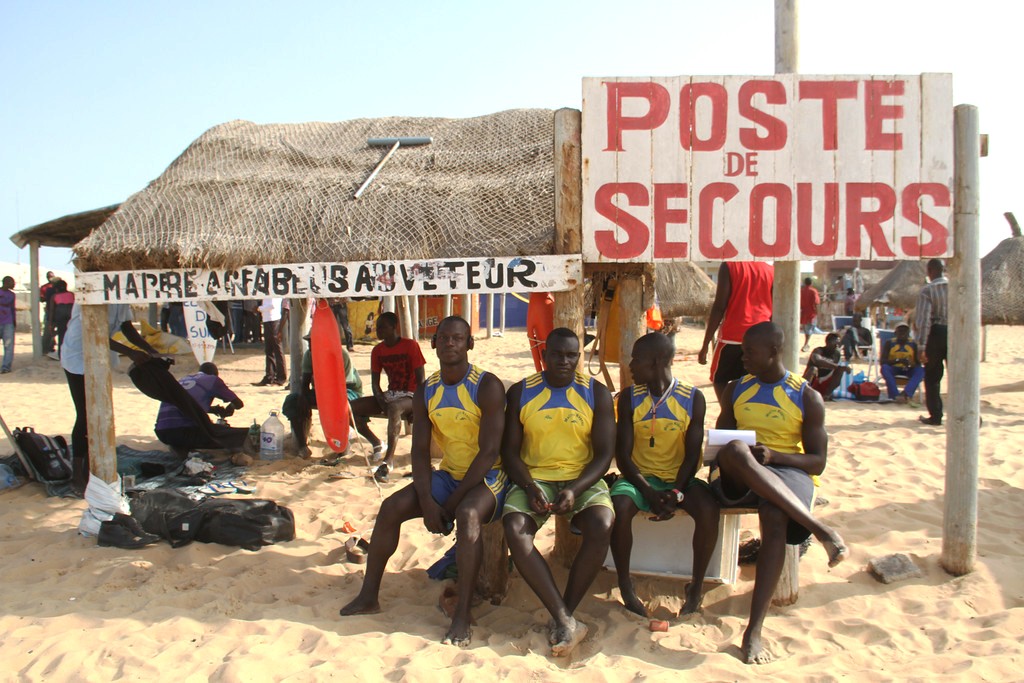
At Yoff BCAO beach, one of Dakar's wildest and most dangerous, it's Sunday and there are about 2000 people, many of them unaccompanied children and teenagers. They form a seething, laughing, splashing shoreline mass; they're all having fun, but it's noticeable that none of them venture out of their depth. Small boys fill up water bottles as floats, a dangerous practice that means they risk being carried out to sea. None of them have armbands or proper floats. I speak to the urchins playing on the shore and they all say they cannot swim. Unanimously, they grin and tell me they'd love to learn.
My involvement with Yoff beach goes back to October 2011, when I met a group of Dakarois who operate a rudimentary lifeguarding service here. Led by Moustapha Diene, 52, a former fishermen, and Idrissa NDiaye, 33, a professional fireman and freediver, both from the Lebou tribe, they began saving lives voluntarily because they couldn't bear to stand back as so many children drowned. Despite a tangible decrease in the number of drownings on this stretch of the beach since they began surveying it, the government is reluctant to give them further funds and equipment. They get by with a few adapted fishing floats, a tank of oxygen, an old windsurfing board - and superlative swimming skills. It occurred to me that they could do with talking to our British lifesaving experts, the RNLI.
After months of hard work and not a little drama (our race through the hot streets of Dakar, looking for the right visa form, Moustapha sporting a kingly silver robe, is particularly memorable), Idrissa and Moustapha are now enrolled on the Royal National Lifeboat Association's (RNLI) brand new Development Programme. The programme will bring two lifeguards from nine developing countries (Senegal, Cameroon, Kenya, Uganda, Tanzania, Mauritius, Bangladesh, India and the Philippines) to a summer lifeguarding camp at the RNLI headquarters in Poole this August, for two weeks' intensive leadership training. During the winter, the RNLI lifeguards will return to Senegal (and the other countries) to help Idrissa and Moustapha improve their service and carry on training future lifeguards.
Drowning is preventable. The RNLI has years of experience in saving lives at sea, on inland
waterways and in floods. The programme is designed to share that expertise to reduce drownings worldwide, providing others with the knowledge, equipment and skills to save more lives and bringing to Africa the kind of superior lifeguarding services that we so take for granted on the beaches of the South West every year. Dakar's maitres naguers sauveteurs are really good, but with further training by the RNLI they'll have the base knowledge to improve and expand their service.
It's a significant start - but there's more to be done. In the long term, Idrissa, Moustapha and I would like to link up with NGOs like the one I work for - child rights organisation Plan International - and introduce free swimming lessons for children in Dakar and eventually, the rest of Africa. We'd also like to help the RNLI link up to further lifeguarding services in Africa.
Swimming is rightly considered, here in the UK and most other developed countries, to be a fundamental life skill. Teach a child to swim and he or she will always swim. Teach a child to swim in Africa and he or she also has more chance of surviving in rough seas; more chance of surviving a flood; more chance of surviving that tricky river crossing on the way to school. If a child is taught swimming survival and safe rescue skills, he or she will use them to protect their peers. Grown-up, they will pass those skills on to their own children. I would argue that teaching a child to swim in a city such as Dakar is as important as vaccinating them against major diseases.
Idrissa brings the point home as he describes, visibly upset, an accident that happened this week in Malika, on the outskirts of the city.

Sunday, December 2, 2012

Les Fanals Festival

Les Fanals Festival
Lantern Festival


This festival typically from Saint-Louis, takes place during the last week of December, this is a night parade. Real full-bodied works, buildings representing the city of St. Louis up to 5 m high, covered with brightly colored wallpaper.
The parades of these fanals, illuminated from within by candles, is accompanied by 
singing and the beat of drums. The St. Louisiennes, coated Signares required to, bring the past of the old colonial city. This event is a real contest of ingenuity and délégance between the neighborhoods of St. Louis.

Sunday, May 27, 2012

Senegal Tennis

- Senegal Tennis -
Senegal Tennis

Tennis has been played in Senegal since colonial times and our federation is among the oldest in Africa.
Tennis saw a surge in popularity  in Senegal particularly in the 80's and 90's with some excellent performances by players like Yaya DOUMBIA (who had won several major awards at the international level), but also sisters 
Yaya DOUMBIA
BERTHA
(several times champion of Africa). Plus the strong performance of their Davis Cup team which for a long time, was one of the best in Africa.

That was the Golden Age of Tennis in Senegal.
Currently the federal team headed by President Issa Mboup, strives to find solutions to impove the state of Senegal Tennis.
-The five-year plan for Senegal Tennis -
Senegal Tennis
The overall objective is to develop sustainable quality and quantity in the Senegalese courts.


The specific objectives, these are:
  •  To discover and play tennis in 3000 thanks to young Senegalese JTI (Junior Tennis Initiative);
  •  Perform technical missions in the regions;
  •  Motivate technicians;
  •  Form (or initiate) each year 30 students INSEPS;
  •  Increase the number of licensees by 50%;
  •  Double the number of youth tournaments;
  •  To involve local authorities in the management of tennis;
  •  To organize international tournaments for young men and women;
  •  To host the regional center of the ITF young West Africa;
  •  To integrate all existing programs;
  •  Strengthen the administrative structure of the TSP;
  •  To study the structure of the organization of the TSP compared with current regulations to the Department;
  •  Develop a marketing plan and communication at the point of practitioners and the public to support the development program.
For more information on Senegal Tennis visit Senegal Federal Tennis site
Home Page Senegal Soul

Sunday, May 6, 2012

Senegal revokes licences of foreign fishing trawlers


Senegal Fishing
Government demands that 29 ships offload their catches before leaving the west African country's territorial waters.

The new government of Senegal has cancelled the licences of 29 foreign fishing trawlers, demanding that they offload their catches in the capital Dakar before leaving the west African country's territorial waters.

The dramatic move on Tuesday by fisheries minister Pape Diouf follows growing resentment at overfishing and alleged corruption of the previous government's licencing system. It is expected to defuse threats by Senegal's 52,000 small-scale inshore fishermen to take direct action against the owners of foreign trawlers.

In 2006, Senegal cancelled its licencing agreements with the heavily subsidised EU fleet in an attempt to protect its industry from foreign vessels. But dozens of giant 10,000-tonne factory ships registered in Russia, Lithuania, Morocco, Ukraine, Mauritius, Saint Vincent and the Grenadines, China, Belize and elsewhere were able to acquire new licences. Using satellite technology and often working together, they have been able to take hundreds of tonnes of fish a day.

Read the rest of the story by  John Vidal.....

Senegal revokes licences of foreign fishing trawlers....

Sunday, February 26, 2012

Presidental Elections


DAKAR, Senegal — Voters booed Senegal’s president as he went to cast his ballot in elections Sunday, the latest sign of how his decision to seek a third term in office has caused his popularity to plummet and divided a country long considered a model of tolerance.

The unrest has threatened the reputation of this normally unflappable republic on Africa’s western coast, which has been held up as one of the continent’s most mature democracies. Read the Rest of the Story

Thursday, February 9, 2012

Vlisco the Color of West Africa


Vlisco, the True Original
The Senegal Blog
African Fashion
Since 1846 Vlisco has been designing and producing colourful fashion fabrics that form an essential part of the lively West and Central African culture. Vlisco has an innate sense of the expressive and creative strength of African consumers and, for generations, has succeeded in surprising and inspiring her passionate clientele with unique designs. As the sole authentic designer and manufacturer of such fabrics as ‘Wax Hollandais’, Vlisco is unparalleled when it comes to quality, professional skill and innovation.

African Fashion
The Vlisco strategy is aimed at enabling well-to-do African women to experience the brand in all her facets and to maintain the leading position, not only in the area of design, but also in terms of total brand orientation. Developments take place at neck-breaking speed in Africa and Vlisco aspires to inspire and gain the loyalty of younger generations as well. Innovation is therefore an essential element within the company. In keeping with this, a new collection is launched every quarter, featuring a specific theme in which international trends in a variety of areas are translated into distinctive Vlisco designs.

African Fashion
Furthermore, every quarter a new Vlisco fashion and accessories collection is launched in the four Vlisco Boutiques in Africa. The clothing lines serve largely as a source of inspiration for consumers, who often have their clothing made by a personal tailor. With a complete line of bags, shoes and jewellery, women can clothe themselves in Vlisco from head to toe.

African Fabric
The core element in Wax Print is of course the wax. Using two deep engraved copper rollers, with the mirror image of the design, the two sides of the cotton fabric are printed with a pattern of melted wax, hence the name Wax Print. The fact that the cloth is printed on both sides enables you to wear the product either side. This is the true sign of a quality wax print. Following this, the cloth is immersed in a bath of dye, often Indigo, that penetrates into the areas that are not covered with wax. After the wax as been washed off in varying stages, a negative image of the printed pattern remains on the cloth. This intricate wax printing process results in unique effects that makes the product so outstanding. In fact, not one single centimetre of fabric is identical to the other!Vlisco. The true original. Click here to visit website.

Vist our page for African Fabric and the HML fabric Market

Dakar Fashion Week and Senegalese Fashion designer Ounou SY


Thursday, January 12, 2012

Saint-Louis- Senegal -UNESCO World Heritage Site

Saint Louis - Senegal
Saint-Louis- Senegal -UNESCO World Heritage Site
Saint-Louis, or Ndar as it is called in Wolof, is the capital of Senegal's Saint-Louis Region. Located in the northwest of Senegal, near the mouth of the Senegal River, and 320 km north of Senegal's capital city Dakar, it has a population officially estimated at 176,000 in 2005. Saint-Louis was the capital of the French colony of Senegal from 1673 until 1902. From 1902 until its independence from France the capital was Dakar. From 1920 to 1957 it also served as the capital of the neighboring colony of Mauritania. 

Geography
Saint Louis - Senegal Map
The heart of the old colonial city is located on a narrow island (just over 2 km long and about 400 m wide) in the Senegal River, 25 km from its mouth. At this point the river is separated from the Atlantic Ocean to the west by a narrow sand spit, the Langue de Barbarie (300 m wide), which has also been urbanized (the seaside neighborhoods of Ndar Tout and Guet Ndar). Yet a third part of the city, Sor, lies on the eastern mainland and is nearly surrounded by tidal marshes. Saint-Louis is situated on the Mauritanian border, though the border crossing is at Rosso, 100 km upstream.Three characteristics give Saint-Louis its distinctive geographic appearance: the Sahel, the marshes and the Langue de Barbarie.

Saint-Louis only has two seasons, the rainy season from June to October, characterized by heat, humidity and storms, and the dry season from November to May, characterized by cool ocean breeze and dust from the Harmattan winds. Saint- Louis unfortunately is known for its floods. 

Saint Louis - Senegal
History
Saint-Louis was established in 1659 by French traders on an uninhabited island called Ndar.It was the first permanent French settlement in Senegal. Saint Louis became a big trading post for the Senegal River. Slaves, hides, beeswax, ambergris and, later, gum  were exported between 1659 and 1779. As in Gorée, a Franco-African Creole, or Métis, were important to the economic, social, cultural and political life of the city. They created a distinctive urban culture characterized by public displays of elegance, refined entertainment and popular festivities.  A Métis mayor was first designated by the Governor in 1778. 

Saint Louis - Senegal  Faidherbe Bridge
Louis Faidherbe, who became the Governor of the Colony of Senegal in 1854. His large-scale projects included the building of bridges, provisioning of fresh drinking water, and the construction of an overland telegraph line to Dakar. Saint-Louis became capital of the federation of French West African colonies in 1895, but relinquished this role to Dakar in 1902. Faidherbe Bridge is the the symbol of the city.

Saint Louis - Senegal
Tourism
Following independence, when Dakar became sole capital of the country, Saint-Louis slipped into a state decline.Saint-Louis, however, has remained an important tourist and trading center and the city's economy, though not entirely recovered, is gradually reviving.Today, rich in three centuries of history, in cultural background, geography, architecture and other characteristics, Saint-Louis is a bridge between the savanna and the desert, the ocean and the river, tradition and modernity, Islam and Christianity, Europe and Africa.

Saint-Louis' colonial architecture along with its location on an island at the mouth of the Senegal River and the system of quays.This gives Saint-Louis the distinctive appearance and identity that has made it since 2000 a UNESCO World Heritage Site.Home to a society with a distinctive lifestyle, Saint-Louis has retained its unique identity. “No one comes without falling in love with the city," proudly say its people who consider Saint-Louis as the birthplace of Senegalese Teranga, the Wolof word for hospitality.

Saint-Louis remains the most characteristically French colonial destination in West Africa along with Gorée Island.

Attractions and Events
Saint Louis - Senegal
  • Saint-Louis’ Research Center
  • Governor’s Palace
  • Historic airport at Dakar-Bango 
  • Grande Mosquée
  • Faidherbe Bridge 
  • Servatius Bridges
  • Fanals, which are night-time processions of giant paper lanterns, take place at Christmas time.
  • The Saint-Louis Jazz Festival
  • The Festival Métissons
  • Annual Reggata
  • The Magal of the Niari Rakas

Saint Louis - Senegal
The People
The Wolofs and Lebous who are the main inhabitants of Saint-Louis are mostly fishermen that live in fishing communities like Guet-Ndar on the Langue de Barbarie. The Fulas live in the inland and practice pastoral farming. The Maures who are migrants from Mauritania (Saint-Louis Senegal is less than six miles south of the border with Mauritania) are mostly merchants, traders and shopkeepers found everywhere in Saint Louis.

Monday, January 9, 2012

Lodge des Collines de Niassam -Palmarin / Sine-Saloum

Lodge des Collines de Niassam -Senegal
Lodge des Collines de Niassam
Only four hours from Dakar, this is an eco-resort in the delta of the Saloum river .
Only 13 individually designed rooms on an ideal site. Wake up in the morning in the arms of a powerful baobab. Breakfast will be served with a smile. Contemplate the golds and carmines of dawn from your private terrace, fulfilled and content. A beautiful day has started.

The Library
At the Lodge we multiply the opportunities to 

Lodge des Collines de Niassam -Senegal

encounter Africa.The library can offer you a selection of African literature: African writers, explorers’ stories, cultural studies ……And also novels, detective stories, strip cartoons and children’s books.

The Restaurant
You will be treated with fresh basic products with local flavors: Bissap, the flower of Africa, the baobab fruit known as “monkey bread” or tamarind fruit.The sheer choice of the day’s fishing catch means we can offer fresh fish to taste marinated and accompanied by a cucumber and tomato sorbet, or simply grilled with a sauce of creative flavours. You’ll also love the village duck simmered with cashew fruit honey or zebu in a spicy marinade. Ending with a ginger sorbet or the more classical grapefruit or lime sorbet.
Lodge des Collines de Niassam-Senegal

The Pool
It’s up to you : cool down in the swimming pool while tasting one of our cocktails or , if you prefer to swim in the lagoon – a natural and beautiful spot. For those of you with more energy, a dip in the ocean is a half-hour walk away.


Accommodations.

Lodge des Collines de Niassam-Senegal
You have your choice from four different types.Guests can relive a childhood dream, sleeping in one of the tree houses set in a majestic baobab tree; built over 3 levels,.In one of the stilted water lodges. A stylish mud lodges in the grounds with their wooden and straw roofs, or finally Berber style in a tent.


Contact
In Sénégal : Lodge des Collines de Niassam
Palmarin Ngallou, BP 08 JOAL - Sénégal

Lodge des Collines de Niassam-Senegal

Phone:
In Sénégal
(00221) 77 639 06 39
 In France
0033 6 24 70 75 99

Email :resa@niassam.com

Website :  niassam.com


Palmarin Nature Reserve - Senegal


Palmarin Reserve - Senegal

Palmarin Nature Reserve - Senegal

Another one of the best places to visit in Senegal’s southern region is the . Palmarin Nature Reserve is located at the southern tip of the Petie Cote above the Sine-Saloum Delta. It is close to the border with The Gambia. Visitors to Palmarin can enjoy the area’s beaches, go on river cruises through the delta,

The majority of the area’s residents live in one of five villages, from north to south Ngallo, Ngueth, Gounamane, Diakhanor and Djiffer. The dominant industries in the area are traditional fishing and tourism. Other smaller industries include salt, oyster and clam harvesting. The dominant ethnic group in the area is Sereer, speaking a distinct Soloum area dialect. French and Wolof are secondary languages also commonly spoken.

Palmarin Reserve - Senegal
Palmarin Nature Reserve’s 10,430 hectares of pristine coastal environment includes a combination of Atlantic seaboard, shallow inter-coastal mangrove channels, and expansive low-level salt flats. Wildlife in the reserve is diverse and plentiful from the elusive hyena, mongoose and monkeys to the broad spectrum of permanent & migratory birds that pass through the region.

Palmarin Reserve - Senegal
Bird Watching - The region of Senegambia is a bird watcher’s dream, hosting over 600 species of migratory and resident avifauna. Due to the unique convergence of coastal, estuary and forest habitat, Palmarin Nature Reserve provides an ideal opportunity to view many of these species in a single locale.

One way of getting around Palmarin is via a horse driven cart or Charret. Charrets make accessing Le Reserve de Palmarin, the local villages and even the beaches an easy task. At the same time it lets visitors experience travel on a local level and a pace that lets you take in all your surroundings. Tours are organized on request and accompanied by an experienced guide knowledgeable on the local environment and culture.

Accommodations

  • Djidjack, Palmarin Gounoumane, ☎ (221) 33 949 96 19 (campalmar@orange.sn),
  • Lodge de Palmarin, Palmarin Diakhanor, ☎ (221) 33 957 12 56 (tpa@sentoo.sn)
  • La Pointe de Sangomar, ☎ (221) 77 536 44 25.  
  • La Tulip Noire, Palmarin Diakhanor, ☎ (221) 77 636 70 01. 
  • Lodge des Collines de Niassam, ☎ (221) 77 639 06 39 (resa@niassam.com),
  • Palmarin Reserve - Senegal


  • Yokam, Palmarin Gounoumane, ☎ (221) 77 567 01 13. 

Thursday, January 5, 2012

Radisson Blu Hotel - Dakar Senegal

Radisson Blu Hotel Senegal
Radisson Blu Hotel - Dakar Senegal
Hotel boasts a prime Dakar waterfront location and a Five Star rating. A gem among hotels in Dakar, the Radisson Blu Hotel is nestled in the heart of the Fann Corniche, amongst glamorous beaches, embassies and lavish villas. Part of an exclusive complex composed of high-end retail shops, an incredible 1,500-square-metre spa and upscale apartments, this hotel offers serenity only a short walk from the bustling Dakar city centre and prime Senegalese attractions. The hotel is also convenient to Dakar Léopold Sédar Senghor International Airport. Start the day absorbing a rich West African culture at the IFAN Museum, then stand in awe of the beautiful Grande Mosque and compelling history of Gorree Island. Return to the luxurious Radisson Blu Hotel, Dakar to relax, and enjoy a memorable view of the Atlantic Ocean.Dakar restaurants serve gastronomic cuisine and grilled favorites

Radisson Blu  Dakar Senegal

Dining
The Radisson Blu Hotel, Dakar boasts two restaurants, L'Avenue and Pool Side Restaurant, that guarantee to dazzle and delight. Savour an authentic Mediterranean meal in L'Avenue's warm, inviting atmosphere or indulge in a variety of game dishes grilled to perfection at the exquisite Pool Side Restaurant. In the warm months, lounge poolside with a refreshing cocktail or mixed drink at the hotel's Pool Bar.

L'Avenue
Offering the best of the best Mediterranean-inspired restaurants in Dakar, L'Avenue Restaurant's tantalising menu treats guests to an unforgettable meal in Senegal. The restaurant's kitchen team prepares an alluring Mediterranean-inspired menu using only the freshest ingredients. Whether stopping by for a quick lunch on the go or indulging in a romantic dinner for two, guests enjoy the perfect hotel dining experience in L'Avenue's charming, modern ambiance.

Radisson Blu  Dakar Senegal

Pool Side

Enjoy a relaxing meal beside the ocean waves at the Pool Side Restaurant, featuring barbecue specialties and a delicious à la carte menu. Guests can also relax to the sound of the waves or the live music.

Pool Bar

Bask in the warm African sun with a wide variety of refreshments guaranteed to quench any thirst. This poolside bar boasts an extensive international menu of wine, beer and cocktails served along with an assortment of juices and other non-alcoholic beverages.

Rooms

Radisson Blu  Dakar Senegal

This chic hotel boasts 180 exclusively designed guest rooms, including Business Class Rooms and Suites. Fusing contemporary style with classic African elegance, these Dakar hotel rooms make for the ideal retreat after a long day under the African sun. All rooms feature lush furnishings, Free high-speed, wireless Internet access, coffee and tea provisions, mini bar, individual climate control, LCD television and a spacious work desk. Steps from majestic beaches and a short walk to lively city centre Dakar, this exemplary accommodation affords guests picturesque views of the Atlantic Ocean and city pleasures from a stylish base of serenity and comfort.
Services
Relax body and mind with five-star hotel services.This Dakar retreat offers spa and wellness services that treat guests to a relaxing getaway in Cape Verde. Whether lounging by the hotel's Olympic-sized pool or indulging in a variety of spa and beauty treatments, guests of this five-star hotel enjoy premier Dakar services and facilities offering great possibilities for relaxation and rejuvenation. Free highspeed internet. Take advantage of the hotel's 100% Guest Satisfaction policy, and see why this destination stands out as a gem in Dakar.


Contacts
Radisson Blu Hotel, Dakar
Route de la Corniche Ouest
Radisson Blu Dakar Senegal Map

BP 16868
Dakar Fann, Sénégal

Tel: +221 33 869 33 33
Fax: +221 33 869 33 66

E-mail: info.dakar@radissonblu.com

Tuesday, January 3, 2012

Lamantin Beach Resort & Spa - Saly Senegal

Lamantin Beach Resort & Spa

Completely renovated in 2011, Saly resort located on the edge of a long and large sandy beach has many strengths. 
145 rooms and suites distributed in round huts in a garden with various species and in the main building overlooking pool and ocean. 

Spacious, comfortable and well equipped, fully restyled by a designer who combines comfort and decoration. All inspired by African art and all items are manufactured by craftsmen of Senegal.Many elements and local materials were incorporated such as laterite bricks, woven cloth or the local woods .


Located on the seafront with direct access to the beach and the marina, the 
Lamantin 
Lamantin Beach Resort & Spa
Beach Hotel is a world of well-being in the heart of the beautiful resort of Saly. Built in an African style, it is composed of traditional huts, luxuriously appointed and decorated in the finest tradition Style. All rooms and suites offer great comfort and a terrace.

RESTAURANTS
•  Lamantin, restaurant around the pool with a surface area of 220 m2, buffet show cooking for breakfast and dinner, the restaurant is air conditioned.
•  "The Earth PORT" , restaurant, outdoor bar with entertainment on the marina area of 500 m2 with air-conditioned game room, service buffet or a la carte lunch
"The Beach Club" , restaurant bar-lounge of 120 m2 air-conditioned à la carte dinners, music and dancing terrace of 220 m2 directly on the beach to a restaurant lighter lunch, snacks during the afternoon.
Beaches and pools
The hotel has a beautiful sandy beach equipped with chairs and huts for protection from the sun, a beach attendant is available to guests. The pool of 400 sqm in the heart of the resort will allow you to refresh yourself after sunbathing.


Lamantin Beach Resort & Spa


SPA
SPA Premier of West Africa with international standards, the property offers an exceptional quality.
The center includes: 

  • - A leisure pool Hydrotherapy 
  • - Balneotherapy 
  • - affusion 
  • - showers 
  • - 14 treatment rooms 
  • - Hammam 


  • Lamantin Beach Resort & Spa
  • - Area consultation 

The fishing center
The fishing resort Saly Fishing Club was founded at the initiative of Jean Touly, the owner, developer of real estate project "Residents of Port", the resort " Lamantin Beach Hotel " and a passion for fishing and Africa. It is at this day, one of the largest fishing resort in West Africa and around the world with eight boats. You will discover a harbor, a gift shop, a bar, a repair shop, etc .
ANGLING CENTRE
The center currently has six fully equipped boats for fishing for billfish. They are all equipped with echo sounder, radio, GPS, Poles, etc. .... The engine is powerful is can happen very quickly on the fishing grounds. Every year in July the fishing center organizes an international competition.
Reservations 

Website: http://www.lelamantin.com/
Lamantin Beach Resort & Spa

Monday, January 2, 2012

Accrobaobab Adventure Park - Senegal

Accrobaobab Adventure Park - Great Day Trip from Dakar or Saly

Accrobaobab Adventure Senegal


Accrobaobab Adventure Park  is the only park in the world built exclusively on baobabs.Located in the bush in the Senegalese sole baobab forest of our planet, this park welcomes you 5 to 77 years for unforgettable adventures safely.

Accorbaobab Adventure Park Map


A 65 km south of Dakar and 15 km from the resort of Saly, the park is easily accessible for all types of vehicles. To get there, take National 1: track to right across the reserve Bandia, 5 km from Sindia.